
Barcelona & Madrid: Spain Guide for Israelis
Barcelona & Madrid: Spain Guide for Israelis
Spain is one of those destinations that keeps pulling Israelis back. And the numbers prove it: out of the 33,193 flights we track on Wingly's flight board, 764 of them fly to Spain. That puts it comfortably in the top 7 destinations from Ben Gurion. Madrid alone accounts for 562 flights, Barcelona another 202. You know at least three people who went last year, and every single one of them came back saying "you HAVE to go."
They're right. But most of them only scratched the surface.
They walked Las Ramblas shoulder-to-shoulder with ten thousand other tourists, paid 18 euros for sangria that tasted like Sprite with food coloring, ate "paella" from a place with laminated menus in twelve languages, and called it a trip. Spain deserves better than that. And so do you.
Here's how to actually do it.
Barcelona: Stop Walking Down Las Ramblas
I need to get this out of the way immediately. Las Ramblas is the most overrated street in Europe. Fight me. It's a 1.2-kilometer gauntlet of overpriced restaurants, pickpockets, living statues nobody asked for, and souvenir shops selling the same flamenco magnet in forty colors. Walk down it once to say you did, then never go back.
Barcelona's magic is everywhere except the tourist corridor. Here's the real playbook:
Sagrada Familia -- But Do It Right
Yes, obviously go. Gaudi's unfinished cathedral is one of the most mind-bending buildings humans have ever constructed, and it's been under construction since 1882. The interior is what gets you -- those tree-like columns and the way afternoon light pours through the stained glass turning everything into a kaleidoscope. Photos don't do it justice. Not even close.
Book your ticket online weeks in advance. This is non-negotiable. Walk-up tickets don't really exist in any practical sense. Get the morning slot (9 AM) for the best light through the east-facing windows. The tower access upgrade is worth it for the views and the spiral staircases, but skip it if you're claustrophobic -- those stairs are tight.
Insider Tip: The Nativity Facade side has the best exterior detail and morning light. If you only have time for one tower, pick the Nativity side over the Passion side. The Passion towers are taller, but the Nativity carvings are Gaudi's actual work.
The Gothic Quarter (Barri Gotic)
This is the Barcelona most tourists miss because they're too busy on Las Ramblas, which literally borders it. The Gothic Quarter is a maze of medieval streets, hidden plazas, and buildings that predate Columbus. Get lost in it deliberately. You'll stumble onto tiny tapas bars, street musicians playing in 800-year-old courtyards, and the Barcelona Cathedral (which is NOT the Sagrada Familia -- tourists confuse them constantly).
The best tapas in Barcelona hide in this neighborhood. Look for places with handwritten menus, standing room only, and old men arguing about football at the bar. If the restaurant has an English menu displayed outside, keep walking.
El Born & La Barceloneta
El Born is the neighborhood where design-conscious locals actually hang out. It's got the Picasso Museum, incredible cocktail bars, and the best boutique shopping in the city. From there, it's a straight walk to La Barceloneta -- Barcelona's beach neighborhood.
Here's what nobody tells you about La Barceloneta beach: it's fine. It's a city beach. The water is decent, the sand is okay, it's packed in summer. It's not Haifa beach, it's not Eilat, it's a Mediterranean city beach. The reason you go to La Barceloneta is for the seafood restaurants one block inland. Grilled fish, patatas bravas, a glass of cold Albariño wine, afternoon sun. That's the experience.
Montjuic
The hill overlooking the city with the castle, the Olympic stadium from 1992, botanical gardens, and the single best panoramic view of Barcelona. Take the cable car up (or walk if you're feeling ambitious) and spend a half-day. The Joan Miro Foundation up here is excellent and rarely crowded.
Madrid: The City That Doesn't Start Dinner Until 10 PM
Madrid hits different than Barcelona. Where Barcelona is Mediterranean and beachy and Catalan, Madrid is intensely, unapologetically Castilian Spanish. It's the capital. It has swagger. And its daily schedule will break your Israeli brain despite us being late-night people ourselves.
Lunch happens at 2 PM. Dinner at 10 PM. Clubs open at midnight and peak at 3 AM. On a Tuesday. Madrid doesn't sleep and it's not trying to. If you're the type who eats dinner at 7 PM, Madrid will gently retrain you.
The Prado and the Art Triangle
The Prado Museum is one of the three or four greatest art museums on Earth. Velazquez's Las Meninas, Goya's Black Paintings, Bosch's The Garden of Earthly Delights -- all here, all in person, all hitting harder than any reproduction you've seen. Budget at least three hours and accept you won't see everything.
Right nearby are the Reina Sofia (Picasso's Guernica lives here -- it's enormous and devastating) and the Thyssen-Bornemisza. Together they form Madrid's "Art Triangle." If you're any kind of art person, you could spend three days on these three museums alone.
Insider Tip: The Prado is free every day from 6 PM to 8 PM. The Reina Sofia is free Monday and Wednesday-Saturday evenings. Plan your visits around the free windows and spend the money you save on jambon iberico instead.
Retiro Park
Madrid's Central Park equivalent, except arguably more beautiful. Rent a rowboat on the lake, wander through the Crystal Palace (a stunning glass pavilion that hosts contemporary art), and just exist for a few hours. After the intensity of Madrid's streets, Retiro feels like a different dimension. Sunday morning here is peak Madrid -- families, couples, old men playing chess, someone always playing guitar somewhere.
Tapas in La Latina
Sunday tapas crawl in La Latina is a borderline religious experience. After the El Rastro flea market (every Sunday morning, go early), the entire neighborhood of La Latina fills with locals bar-hopping from one tapas spot to the next. Each bar, one or two dishes, one drink, move on. This is how Madrileños actually eat, and it's the most fun you'll have with food in Europe.
Key stops:
- Juana La Loca -- their tortilla de patatas with caramelized onion is famous for a reason
- Casa Lucas -- creative tapas, small space, worth the wait
- Cava Baja street -- the entire street is tapas bars. Just walk and follow your nose
Nightlife
Madrid's nightlife is legendary and I'm not exaggerating. Malasaña neighborhood for indie bars and a younger crowd. Chueca for the LGBTQ+ scene and some of the best cocktail bars in the city. La Latina for a more traditional Spanish evening out. Huertas for a bit of everything.
The rules: don't show up to a club before midnight. Don't expect to be home before 4 AM. Don't fight it. This is Madrid.
Barcelona vs Madrid: How to Choose
This is the question every Israeli planning a Spain trip asks. Here's the honest breakdown:
Choose Barcelona if you:
- Want beach + city in one trip
- Love architecture and visual art (Gaudi is Barcelona's DNA)
- Prefer a more relaxed, Mediterranean pace
- Are traveling in summer and want to swim
- Like your nightlife ending by 2-3 AM (still late, just not Madrid late)
Choose Madrid if you:
- Live for food and especially tapas culture
- Want world-class museums (Prado alone justifies the trip)
- Love nightlife that goes until dawn
- Prefer a more "authentically Spanish" atmosphere
- Want easier day trips (Toledo, Segovia)
The vibe difference is real. Barcelona feels more like Tel Aviv -- coastal, creative, slightly rebellious, everyone on the beach. Madrid feels more like... Madrid. There's nothing quite like it. It's a capital city with an ego and the substance to back it up.
And yes, the Catalan vs Castilian thing is a real cultural divide. Barcelona is bilingual (Catalan and Spanish), and Catalan identity runs deep. You'll see Catalan flags everywhere. Madrid is the heart of Castilian Spain. Don't bring up Catalan independence in either city unless you want a very long conversation.
Food: The Real Guide
Spanish food is incredible, but tourist-trap Spanish food is depressing. Here's how to eat like you know what you're doing.
Tapas Done Right
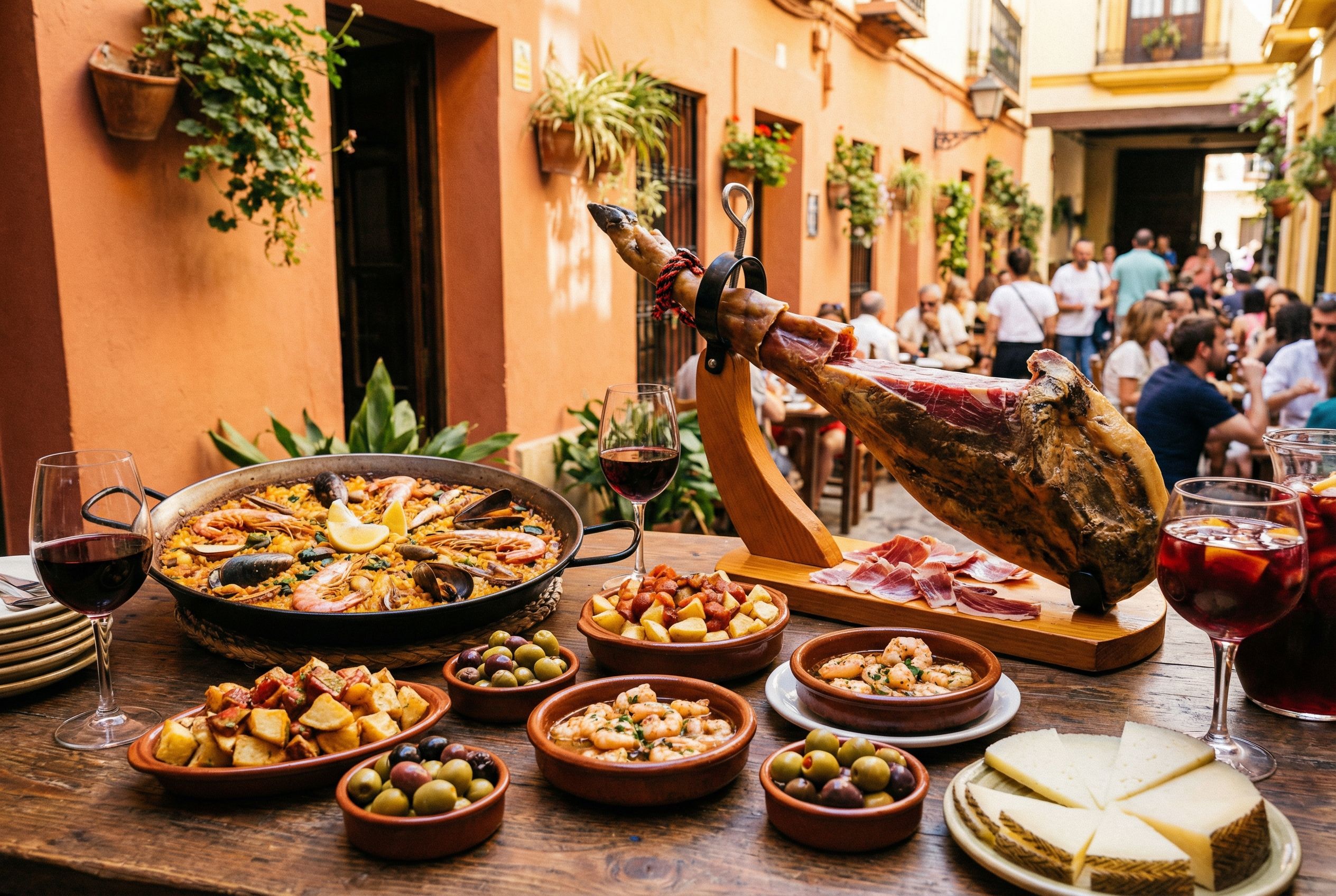
Tapas aren't a meal -- they're a philosophy. You don't sit down and order a bunch of plates at one restaurant. You move. One bar, two dishes, a caña (small beer) or a glass of tinto, and you're out. Next bar. Repeat. A proper tapas crawl hits 4-5 places minimum.
Must-try tapas:
- Jambon iberico -- the ham that costs more than your flight. Worth every cent. Accept no substitutes -- "jambon serrano" is fine but iberico is a different animal. Literally
- Patatas bravas -- fried potatoes with spicy sauce. Simple. Perfect. Every bar does them differently
- Gambas al ajillo -- shrimp in garlic oil, served bubbling hot in a clay dish. Tear bread. Dip. Repeat
- Pimientos de padron -- small green peppers fried and salted. Most are mild, but every few bites one is spicy. Spanish roulette
- Tortilla de patatas -- the Spanish potato omelet. Opinions on whether the center should be runny are the Spanish equivalent of the hummus wars
The Paella Situation
I need to be blunt here. Don't order paella in Madrid. Paella is from Valencia, not Madrid, and what you'll get in most Madrid restaurants is a tourist approximation that would make a Valencian weep. In Barcelona, it's slightly better because of the coastal location, but still -- the best paella you'll find is in Valencia itself or at a dedicated paella restaurant, not a generic "Spanish" place.
If you insist on paella in Barcelona, go to Barceloneta and find a place where locals are eating it. If the paella is ready immediately when you order it, walk out. Real paella takes 20+ minutes.
The Sangria Warning
That "sangria" they're serving you at the touristy restaurant? It's cheap wine, fanta, sugar, and sadness. Real sangria is great. Tourist sangria is a headache in a glass. If you want wine, order tinto de verano instead (red wine with lemon soda) -- it's what Spaniards actually drink when it's hot, it costs half as much, and you won't hate yourself the next morning.
Insider Tip: In Madrid, look for "mercados" (food markets) for the best quality-to-price ratio. Mercado de San Miguel near Plaza Mayor is beautiful but touristy. The real move is Mercado de la Cebada in La Latina or Mercado de Vallehermoso in Chamberi -- local prices, incredible quality, and you can eat at the market stands for a fraction of restaurant costs.
Getting There: Flights from Ben Gurion
Madrid is one of the better-connected Spanish cities from Tel Aviv. Barcelona has fewer options but still solid coverage. Here's what our flight data shows:
Madrid (MAD) -- 562 flights tracked:
- Aero Mexico: 126 flights (connecting, but sometimes surprisingly cheap)
- El Al: 96 flights (direct, your comfort option)
- Iberia: 85 flights (Spain's flagship, direct flights)
- Aerolineas Argentinas: 75 flights (connecting through Buenos Aires -- long way around)
- Iberia Express: 68 flights (Iberia's budget arm, still decent)
- China Eastern: 51 flights (connecting, for the adventurous)
- Air Europa: 51 flights (Spain's #2 carrier, competitive pricing)
Barcelona (BCN) -- 202 flights tracked:
- Iberia: 68 flights (connecting through Madrid usually)
- El Al: 68 flights (direct, the easy choice)
- Blue Bird: 52 flights (Israeli charter, watch for deals)
- Arkia: 10 flights (limited but worth checking)
The key insight: Madrid has nearly 3x more flight options than Barcelona from Israel. If flexibility and price matter (they should), Madrid is the easier city to get to. El Al flies direct to both, Iberia gives you the Spanish carrier experience, and budget options exist if you're willing to connect.
For Barcelona specifically, El Al and Blue Bird are your best direct bets. Check the Barcelona destination page for the latest trends.
Insider Tip: Iberia Express to Madrid is often significantly cheaper than mainline Iberia for essentially the same flight. Same terminal, similar service, lower price. It's one of Europe's better-kept budget secrets.
Day Trips That Are Actually Worth It
From Madrid: Toledo
An hour by train, Toledo is a medieval walled city that was once the capital of Spain. The entire old town is a UNESCO World Heritage Site. It's got cathedrals, synagogues, mosques -- all within walking distance of each other, because for a brief period in history, the three religions coexisted here. As an Israeli, that hits a certain way.
Go early, spend the day, take the train back for dinner in Madrid. Don't buy a sword. I know you want to. Don't.
From Madrid: Segovia
Famous for its Roman aqueduct (2,000 years old and still standing without mortar -- the Romans were not messing around) and the Alcazar castle that literally inspired Disney's Cinderella Castle. Also the birthplace of cochinillo asado (roast suckling pig), which is the most un-kosher thing in Spain and that's saying something. The town is charming even if you skip the pig.
From Barcelona: Montserrat
A mountain monastery 45 minutes from Barcelona that looks like it was carved by aliens. The rock formations are unlike anything in Europe -- jagged, otherworldly, deeply weird in the best way. Take the rack railway up, visit the monastery, see the Black Madonna statue, hike one of the trails. The views over Catalonia are staggering.
From Barcelona: Costa Brava
The rugged coastline north of Barcelona is a world away from the city beaches. Small coves, crystal water, medieval fishing villages. Tossa de Mar is the most accessible, about 1.5 hours by bus. Cadaques (where Salvador Dali lived) is further but worth it if you have time. Summer weekends are packed -- go on a weekday if possible.
Budget: What to Expect
Spain sits in the mid-range of European pricing. It's noticeably cheaper than Paris or London, roughly on par with Italy, and more expensive than Eastern Europe. Here's the realistic breakdown:
Daily budget estimates (per person):
| Category | Budget | Mid-Range |
|---|---|---|
| Accommodation | 150-250 NIS (hostel/Airbnb) | 350-600 NIS (3-star hotel) |
| Food | 80-120 NIS (tapas crawling) | 150-250 NIS (sit-down restaurants) |
| Transport | 20-40 NIS (metro day pass) | 80-150 NIS (including day trip trains) |
| Sights | 0-50 NIS (free evening entries) | 80-150 NIS (museums + attractions) |
| Daily total | 250-460 NIS | 660-1,150 NIS |
Money-saving moves:
- Museum free hours are your best friend (Prado evenings, Reina Sofia evenings)
- Eat at mercados (food markets) instead of restaurants for lunch
- The metro in both cities is excellent and cheap -- never take a taxi within the city center
- Tap water is free and safe in all of Spain. Stop buying bottles
- Wine by the glass at a tapas bar costs 2-3 euros. That same wine in a "wine bar" costs 8-12 euros. Drink at tapas bars
- T-Casual metro cards in Barcelona (10 rides) save about 40% versus single tickets
Insider Tip: Both Madrid and Barcelona have city tourism cards, but do the math before buying. Madrid's card is rarely worth it unless you're hitting every museum on the list. Barcelona's card is better value because it includes unlimited metro rides. But honestly, just paying as you go and hitting free museum hours usually works out cheaper.
The Bottom Line: Do Both
Here's the move that separates smart travelers from everyone else: fly into Madrid, take the AVE high-speed train to Barcelona, fly home from there. Or reverse it. Either direction works perfectly.
The AVE train from Madrid to Barcelona takes 2 hours and 30 minutes, hits 310 km/h, and costs 30-80 euros depending on how far ahead you book. It's city center to city center -- Madrid Atocha to Barcelona Sants. No airport hassle, no security lines, just a smooth ride through the Spanish countryside. Book on Renfe's website a few weeks ahead for the best prices.
The ideal 7-day Spain trip:
- Day 1-3: Madrid -- Prado in the free evening slot, tapas crawl in La Latina, Retiro Park morning, nightlife that goes until the sun comes up
- Day 4: Toledo day trip -- morning train, full day in the medieval city, evening train back
- Day 4 evening: AVE to Barcelona -- arrive late, check in, crash
- Day 5-6: Barcelona -- Sagrada Familia (morning slot), Gothic Quarter wandering, El Born for dinner, Barceloneta beach, Montjuic sunset
- Day 7: Montserrat day trip or beach day -- then evening flight home
With 764 flights between Madrid and Barcelona in our database, finding a good open-jaw fare is very doable. Check Wingly's flight board for the latest options from Ben Gurion, and book your flights into one city and out of the other separately -- it's almost always cheaper than a round trip.
Spain is one of those countries where the gap between "doing it the tourist way" and "doing it properly" is enormous. The tourist version costs twice as much and delivers half the experience. Eat where locals eat. Skip Las Ramblas. Time your museum visits to the free windows. Take the train between cities instead of flying. And for the love of everything, don't order paella in Madrid.
Trust me on this one. Go.