
Berlin & Munich: Germany Beyond the Stereotypes
Berlin & Munich: Germany Beyond the Stereotypes
Germany is Israel's 4th most popular flight destination. Out of 33,193 flights we track on Wingly's flight board, 1,018 of them go to Germany. That puts it right behind Greece, the US, and Italy. One thousand flights. And yet when I tell people I'm going to Germany, half of them say "oh, Frankfurt layover?" No. Nobody is voluntarily spending a weekend in Frankfurt. Well, almost nobody — we'll get to that.
Here's the thing most Israeli travelers don't realize: Germany is three completely different trips depending on which city you fly into. Berlin is the coolest city in Europe and I will die on that hill. Munich is old-world Bavaria at its finest — beer halls, castles, mountains. And Frankfurt, yes, is mostly a transit hub, but it has a few tricks worth knowing about if you're stuck there for 12 hours.
Let's break it all down.
Berlin: Europe's Weirdest, Best City
Berlin is not pretty. Let me just get that out of the way. It's not Prague with its fairy-tale spires, it's not Paris with its Haussmann elegance. Berlin is gray, graffitied, unfinished, and gloriously chaotic. And that's exactly why it's one of the best cities on the continent.
Berlin is also absurdly cheap for a major European capital. We're talking 3-4 euro meals, 2-3 euro beers, clubs with no cover charge that stay open until Monday morning. If you've been overpaying in London or Paris, Berlin will feel like a financial holiday inside your actual holiday.
The Must-See Stuff
- East Side Gallery — a 1.3 km stretch of the Berlin Wall covered in murals. It's free, it's outdoors, and it's genuinely powerful. Go in the morning before the selfie crowds arrive. The famous Brezhnev-Honecker kiss painting is here, along with 100+ other works. This is not a museum — it's the actual Wall
- Museum Island — five world-class museums on an island in the Spree river. The Pergamon Museum alone justifies the trip (the Ishtar Gate of Babylon is there, full-size, and it's jaw-dropping). Get the day pass if you want to hit multiple museums
- Brandenburg Gate — yes, it's touristy. Go anyway. Stand where the Wall used to divide the city. It takes five minutes and it matters
- Reichstag dome — free entry to the glass dome with panoramic views. Book online weeks in advance or you won't get in. This is non-negotiable. Walk-ups don't work
Kreuzberg: Your Neighborhood
Kreuzberg is where you should base yourself. It's Berlin's most vibrant neighborhood — a mix of Turkish, Arab, Israeli, and German cultures that produces some of the best street food in Europe. Oranienstrasse and the area around Kottbusser Tor are the epicenters.
- Mustafa's Gemuse Kebap — the most famous doner kebab in Berlin. The line is insane. Is it worth an hour-long wait? Honestly, probably not when there are a dozen equally excellent kebab shops within walking distance. But if you want the bragging rights, go at an off-hour
- Markthalle Neun — a food hall that does a legendary Street Food Thursday. Stalls from all over the world, 2-5 euros per portion. Go hungry
- Turkish Market on Maybachufer — Tuesday and Friday along the canal. Fresh produce, bread, olives, spices, and the best gozleme (Turkish flatbread) for a couple of euros
Insider Tip: Berlin has a massive Israeli community — estimated at 15,000-20,000 Israelis live there. You'll hear Hebrew on the street in Kreuzberg and Neukolln constantly. This means you can find great hummus, sabich, and shakshuka without trying. Gordon Cafe on Allenstrasse (yes, they named a street after Tel Aviv) is a popular Israeli spot.
Nightlife (Yes, That)
Look, I have to mention Berghain. It's the world's most famous techno club, housed in a former power station, with a notoriously strict door policy. You might wait two hours and get rejected. The bouncers don't explain why. Dress dark, don't look too touristy, go after 2 AM, and for the love of everything don't take photos in the line. Some people get in on their first try, some never get in. That's the game.
But Berlin's nightlife is much bigger than one club. Tresor, Watergate, Sisyphos (an entire abandoned factory turned into a weekend-long party) — the city's club scene is unmatched anywhere in Europe. And most clubs don't charge more than 10-15 euros entry, if anything. Coming from Tel Aviv prices, this feels illegal.
Munich: The Beautiful, Expensive One
If Berlin is the rebellious younger sibling, Munich is the put-together older one who makes more money and has better taste in beer. Munich is stunning, orderly, and expensive. It's everything Berlin isn't, and that's not a bad thing — it's just a different trip.
Old Town
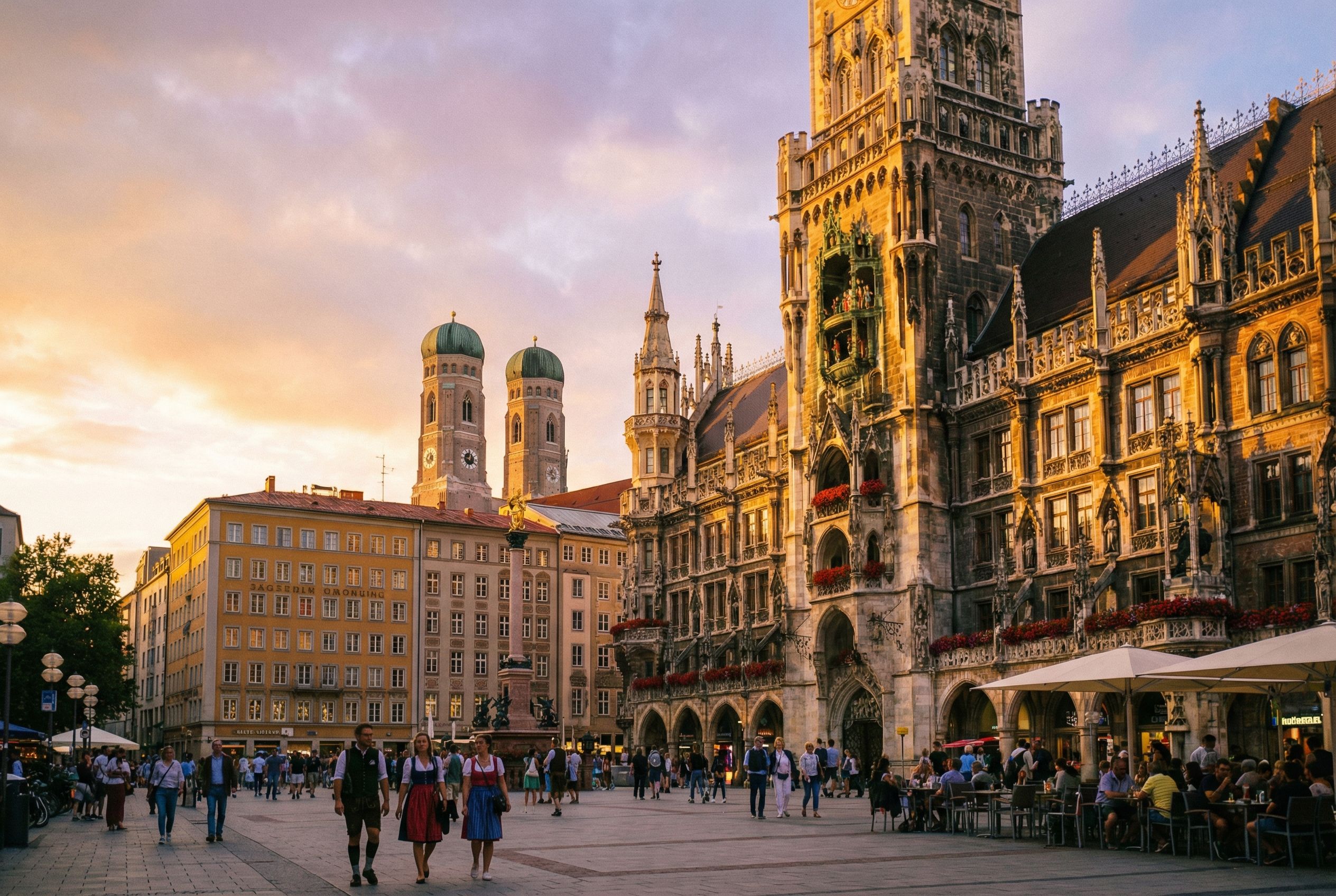
- Marienplatz — the central square, anchored by the Neues Rathaus (New Town Hall) with its Glockenspiel clock that performs at 11 AM and noon. Get there 10 minutes early for a good viewing spot. Is it the most spectacular thing you've ever seen? No. But it's a solid 7/10 and takes five minutes
- Viktualienmarkt — Munich's famous outdoor food market. This is where you eat lunch. Beer garden in the center, specialty stalls around the edges. White sausage (weisswurst) with sweet mustard and a pretzel here is the quintessential Munich experience. Eat weisswurst before noon — it's a Bavarian tradition, and locals will judge you otherwise
- Frauenkirche — the twin-towered cathedral that defines Munich's skyline. Climb the south tower for the best rooftop view in the city, with the Alps visible on clear days
Englischer Garten
This is one of Europe's largest urban parks — bigger than Central Park and infinitely more interesting. On any given afternoon you'll find:
- Surfers on the Eisbach wave (yes, people surf a standing river wave in the middle of Munich. It's wild to watch and completely free)
- Beer gardens — the Chinese Tower beer garden seats 7,000 people and is the second-largest in Munich. Grab a Mass (one-liter beer) and a half chicken. This is not a suggestion
- People sunbathing nude — the Englischer Garten has designated FKK (nudist) areas. Don't be surprised. Don't stare. This is Germany
Insider Tip: The Englischer Garten beer garden at the Chinese Tower is bring-your-own-food friendly. Buy a beer from the garden (you must), but you can bring your own snacks from the supermarket. Many locals do exactly this. It's tradition, not cheapskating.
Day Trip: Neuschwanstein Castle
You know this castle. You've seen it in every "most beautiful places in Europe" listicle. It's the castle Walt Disney modeled Cinderella's castle after. And it's about two hours from Munich by train.
Take the Bayern Ticket (regional day pass, about 27 euros for one person, cheaper if you're in a group) to Fussen, then bus to the castle. Book your timed entry ticket online in advance — walk-ups often sell out by mid-morning in peak season. The castle itself is impressive but the guided tour is brief (about 30 minutes). The real magic is the surrounding landscape — Alpine foothills, lakes, and forest that look like a painting.
Is it touristy? Extremely. Is it still worth it? Yes. Fight me.
Frankfurt: The Layover That's Actually Worth It
Let's be real. Frankfurt is where most Israelis pass through Germany — 657 flights, making it the most-connected German city from Ben Gurion by far. Lufthansa (148 flights), United (144), Brussels Airlines (144), Air Canada (86), and El Al (35) all fly this route. Most of those are connections onward. But if you have a long layover or a spare day, Frankfurt has a few worthwhile cards to play.
Sachsenhausen
Cross the Main river south into Sachsenhausen and you'll find the Apfelwein (apple wine/cider) district. This is Frankfurt's actual personality hiding behind the banking facade. The cider houses here are traditional, no-frills taverns serving cloudy apple wine in pitchers with hearty food. Adolf Wagner and Zum Gemalten Haus are the classics — wooden benches, shared tables, green sauce (Grune Sosse) on everything. It's like discovering a whole different city five minutes from the skyscrapers.
Romerberg
The reconstructed medieval square is genuinely charming, especially during Christmas market season (late November through December). Yes, it was bombed flat in WWII and rebuilt, but the reconstruction is impressive and the half-timbered buildings make for great photos.
The Museum Embankment
Frankfurt has a line of museums along the south bank of the Main river. The Stadel Museum has one of the best art collections in Germany. Most museums are free on the last Saturday of the month.
Insider Tip: If you have 4+ hours at Frankfurt Airport and don't want to go into the city, the airport has a surprisingly decent sauna and shower area in Terminal 1 (Fraport Visitor Center). For a long connection, this beats sitting at the gate scrolling your phone.
The Sensitive Topic
I'm not going to dance around this. Germany, for Israeli travelers, carries weight that other destinations don't. Every Israeli who visits Germany navigates this in their own way, and there's no right or wrong approach.
What You Might Want to Visit
- Holocaust Memorial (Memorial to the Murdered Jews of Europe), Berlin — 2,711 concrete slabs of varying heights in a grid pattern near Brandenburg Gate. It's free, open 24/7, and there's an underground information center with individual stories of victims. Walk through it slowly. Let the disorientation of the maze do its work. Some visitors find it too abstract. Others find it devastating. Both responses are valid
- Sachsenhausen Concentration Camp, just north of Berlin — reachable by S-Bahn train (about 45 minutes from central Berlin). Free entry. Audio guides available. This was one of the first concentration camps built and later became a model for others. Visiting is heavy. Give yourself the whole morning and don't plan anything demanding afterward
- Dachau Concentration Camp, near Munich — similar setup, about 40 minutes by S-Bahn. The first concentration camp established by the Nazis. Free entry, audio guides available. Same advice as Sachsenhausen — don't rush, don't plan much after
- Topography of Terror, Berlin — built on the site of the former Gestapo and SS headquarters. Free museum documenting the institutions of Nazi terror. It's thorough, well-curated, and hard to take in all at once
- Stolpersteine (Stumbling Stones) — small brass plaques embedded in sidewalks across Germany, marking the last chosen residences of Holocaust victims. You'll find them everywhere if you look down. Each one is a name, a date of birth, a date of deportation, a fate. There are over 100,000 across Europe, and encountering them unexpectedly while walking a German street is one of the most quietly powerful memorial experiences you can have
The Emotional Dimension
Many Israeli travelers feel conflicted about enjoying themselves in Germany. Having a great time at a beer garden and then visiting Sachsenhausen the next day creates a whiplash that's hard to prepare for. There's no guidebook advice that resolves this tension — it's personal, it's generational, and it's okay to feel complicated things.
What I will say: Germany has done more to confront its past than arguably any country in history. The memorials are not hidden. The history is taught, discussed, and present in everyday German life. You won't find denial here. Whether that's enough, or what it means for how you feel walking the streets — that's yours to decide.
Food & Drink: Beyond Sausage and Beer
Here's the dirty secret about German cuisine: the real national food is the doner kebab. Germany has about 40,000 kebab shops. That's not a typo. The Turkish gastarbeiter (guest workers) who came in the 1960s and '70s created a food culture that is now more German than schnitzel. The Berlin doner — bread, meat from the vertical spit, salad, sauce — is legitimately one of the best street foods on Earth. And it costs 4-6 euros.
What to Actually Eat
- Doner kebab — everywhere, but especially Berlin. This is your default meal. Trust me on this one
- Currywurst — sliced sausage with curry ketchup. Berlin invented it. It's greasy, it's fast, and at 3 AM after a club it's the greatest thing ever created. Curry 36 and Konnopke's Imbiss are the classic spots
- Weisswurst with sweet mustard and pretzel — Munich specific, eaten before noon. Order at any traditional beer hall
- Schweinshaxe — roasted pork knuckle. This is the thing on every Munich restaurant's Instagram. It's enormous and it's delicious. Split one between two people unless you're training for a strongman competition
- Bretzel (pretzel) — German pretzels are a different species from what you've had elsewhere. Warm, salty, with a dark chewy crust. Buy from any bakery for 1-2 euros. Breakfast of champions
Beer Culture
German beer is outstanding and cheap. A half-liter in a Berlin bar costs 3-4 euros. In Munich, expect 5-7 euros at beer halls, more during Oktoberfest (when everything is more expensive and more crowded and arguably less fun than a normal Munich Tuesday — hot take, but I stand by it).
- Helles — Munich's signature light lager. Clean, crisp, sessionable. Augustiner is the local favorite
- Weissbier — wheat beer, served in tall glasses. Try Paulaner or Erdinger
- Berliner Weisse — Berlin's sour wheat beer, served with a shot of raspberry or woodruff syrup. Sounds weird, tastes incredible on a summer afternoon
- Christmas markets — if you visit November-December, you'll encounter Gluhwein (mulled wine) at every market. It's served in collectible mugs, and yes, you're supposed to keep the mug. Two or three of these on a cold evening and you'll understand why Germans survive winter
Insider Tip: In Munich beer halls (Hofbrauhaus, Augustiner Keller, Lowenbraukeller), the Mass is a full liter. That's three regular beers in one glass. Pace yourself. The beer is strong, the glasses are heavy, and the walk back to your hotel is longer than you think.
Getting There: Lufthansa Wins on Punctuality
Let's talk airlines, because the numbers are interesting. We track all flights from Ben Gurion on our flight board, and Germany's route breakdown looks like this:
Frankfurt (FRA) — 657 flights:
- Lufthansa: 148 flights
- United: 144 flights
- Brussels Airlines: 144 flights
- Air Canada: 86 flights
- El Al: 35 flights
Munich (MUC) — 361 flights:
- Lufthansa: 105 flights
- Brussels Airlines: 102 flights
- SAS: 52 flights
- El Al: 52 flights
- United: 43 flights
Berlin (BER) — 157 flights:
- El Al: 44 flights
- SAS: 43 flights
- Israir: 36 flights
- Blue Bird: 34 flights
The headline stat? Lufthansa averages just 15.5 minutes delay on these routes — the best punctuality of any carrier flying Israel to Germany. Brussels Airlines is close behind at 16.7 minutes. For context, those are excellent numbers. If you've been burned by 2-hour El Al delays before, Lufthansa's German efficiency stereotype is well-earned on this route.
For Berlin specifically, El Al and SAS fly direct, plus you've got budget-friendlier options with Israir and Blue Bird. Direct TLV-BER flights are around 4.5 hours.
Frankfurt and Munich are dominated by Lufthansa and its Star Alliance partners, which makes them excellent connection hubs if you're continuing onward to the rest of Europe or North America. But I'd argue flying into Berlin or Munich and skipping Frankfurt entirely is the move for a pure vacation.
Insider Tip: If you find cheap flights to Frankfurt but actually want to visit Berlin or Munich, check FlixBus or FlixTrain prices from Frankfurt. Berlin is about 5-6 hours by train (Deutsche Bahn ICE) or 7+ hours by bus. Munich is about 3.5 hours by ICE train. Sometimes the Frankfurt flight + train combo beats a direct flight on price.
Budget: Berlin Is Cheap, Munich Is Not
Let me be blunt. Berlin is one of the cheapest major capitals in Western Europe. Munich is one of the most expensive cities in Germany. Planning your budget depends entirely on which city you're in.
Daily budget comparison (approximate, in euros):
| Category | Berlin | Munich |
|---|---|---|
| Doner/street food | 4-6 | 6-8 |
| Sit-down meal | 10-15 | 15-25 |
| Beer (0.5L) | 3-4 | 5-7 |
| Public transport (day) | 8.80 | 9.20 |
| Museum entry | 0-14 | 0-15 |
| Hostel bed | 15-25 | 25-40 |
| Hotel (3-star) | 60-100 | 90-150 |
Berlin is where budget travelers thrive. You can eat three meals, drink beer, see museums, and go clubbing on 40-50 euros a day if you stay in hostels. Munich requires more like 70-90 euros a day for the same quality of experience.
Both cities have excellent public transport — the U-Bahn and S-Bahn systems are fast, frequent, and relatively affordable with day passes. Berlin's system operates on an honor basis (no turnstiles), but don't think about skipping the ticket. Plainclothes inspectors are common, and the 60-euro fine is not a joke.
The Bottom Line
Germany is three different trips, and which one you should take depends entirely on who you are:
Choose Berlin if you:
- Want the coolest, most alternative city in Europe
- Are on a budget (seriously, Berlin is cheap)
- Love nightlife, street art, and street food
- Want to experience the Israeli expat scene abroad
- Care about 20th-century history and want to see the Wall, the memorials, the layers of a city that keeps reinventing itself
Choose Munich if you:
- Want classic European beauty — beer halls, Alpine scenery, castles
- Don't mind spending more for a polished experience
- Love beer culture done at the highest possible level
- Want a base for day trips (Neuschwanstein, Salzburg, the Alps)
- Are visiting during Oktoberfest or Christmas market season
Choose both if you:
- Have 7+ days and want variety
- Want to see the full range of what Germany offers — the gritty and the grand
- Like the idea of a Berlin-Munich train ride through the German countryside (about 4 hours on the ICE high-speed train, totally doable)
Germany isn't the first destination that comes to mind for most Israeli travelers. It's complicated, it's loaded, and it doesn't sell itself with beaches and sunshine. But 1,018 flights from Ben Gurion don't lie — Israelis are going in big numbers, and they're going back. The food is better than you expect, the beer is better than anywhere, the cities are endlessly interesting, and the flights are frequent and punctual.
Check the latest routes on our flight board, look at Berlin and Munich on the destination pages, and book the one that fits. Or book both. Germany can handle it.